That's it. I quit!

This is what I had in my known bugs:

when going to low cover, often shortly pops back up and down when crouched - hard to repro - possibly after reaction fire triggers

Since I have got some free tokens left (5.4, medium):

Yo Codex, I need help fixing a bug. I suspect it originates in TacticalGame/actors/state/Move/sequences/stop.ts and there in the class MoveIntoLowCover when calling MoveIntoLowCover.advance. On the first call, something is causing the actor to briefly stand up again, before the actor finally gets into the expected crouch state. I can not easily reproduce it. Any clue what is going on there?

Cost me 7% and 2min. Codex nailed it. To be clear: this was a bug I have seen once or twice and had no idea how to reproduce. F*cking sweet :heart_eyes:

8 Likes

I have got some free tokens left” II (5.3-Codex Medium)

(…) The purpose of this method is to rotate the spine bone (within a hierarchy of bones) so that the gun, that is attached to a hand bone, points at the target vector. (…)

This did work most of the time but occasionally failed hard. And even harder to reproduce…

Codex to the rescue! First, it suggested 3 fixes. One was irrelevant, but the other two seemed pretty bad (forgot to clone() and to normalize()). Ok, it is still hard to repro and time would have shown how thourough Codex was. But anyway, since this did not eat much credits I kept going.

Can you suggest a better approach than the brute force iterative solver?

OMFG! Codex can. It coded a deterministic yaw/pitch solver. Pretty cool how it integrated the Math, Babylon methods/classes and my own code. Plus, learning experience! How to get e.g. a local pitch axis or how to use a plane to get a desired angle.

Keep in mind this was on 5.3 (latest is 5.5). And very N.B. The code runs on a gltf model with a negatively scaled root node.

On an even more promising note. Is the problem, I tried to solve originally, not of an IK nature? Rotate one bone so that another bone that holds a mesh points into a certain direction? There might be some promising avenues for BoneLookController and BoneIKController particularly since: The BoneIKController class is modeled after Blender's IK Bone Constraint, but is currently limited to 2 bones.

1 Like

“Who needs tokens - use unlimited web AI” (Gemini)

Man this is so simple and so true: player perception is reality

Hey! I can absolutely help with that. This is actually a classic game design dilemma. You’ve hit on a core truth of game development: player perception is reality, and “perfect” math can often feel like a bug to the player.
In an isometric game, if a player sees a clear path to a massive enemy but the shot is blocked by a tiny, 2-inch-wide metal pole, they won’t think, “Ah, realistic collision physics!” They’ll think, “This game is broken.”

I’m with you here. Been coding on Fabel last couple of days. It’s got 95% on SWE bench verified - seems to fix it’s own problems ahead more and hallucinates way less. It’s improved so much in last year that I’m wondering what our runway looks like, since right now it’s the worst it’s going to be! It’s certainly an invaluable tool, but I find it becoming a crutch and I’m not sure if my brain is going downhill now - I hardly struggle through problems and that’s where the most learning for me seems to come from!!

anyway, this is the new normal :smiley:

1 Like

I would not bet on it. AI big techs need to earn money at some point. And then prices will sky rocket. So I grab what I can now - knowing that it is going to be over sooner or later.

Anyway, I have heard that fear quite often recently that our brain are going to rot. But I do not understand why really. Why should I not solve difficult problems anymore (which I love)? I still retain the power over that, don’t I?

After more than 25 years working across different areas of this profession, I’ve never witnessed a technological acceleration as dramatic as the one we’re experiencing today.

Just over a year ago, opening Cursor or Antigravity often meant dealing with hallucinations, broken code, and constant corrections. Today, with a couple of prompts and less than 20 minutes, you can build a complete photo and video platform in Nuxt with uploads, security, and a polished design.

Some days I have three AI agents running simultaneously across multiple projects. In fact, AI is making me work more, not less.

And all of this is happening at an astonishing speed.

A few days ago, I had a meeting with a client that was supposed to focus on interactive experiences for trade shows and conferences. Instead, for nearly an hour, the conversation revolved entirely around AI—how it could optimize workflows, reduce development time, and lower costs.

That meeting clarified something for me.

I set three principles that I’m not willing to compromise on:

  • I’m not going to pay for a tool whose ultimate purpose is to make me earn less.

  • I understand the value AI brings to my projects, and I encourage others to discover how it can improve theirs. But I won’t allow anyone else to define how I should use it or what value I should extract from it.

  • And if someone is pressuring developers today because they believe AI will replace them tomorrow, they may want to take a look in the mirror. Chances are, they’ll be facing the same questions sooner than they think.

The real challenge isn’t whether AI will change our jobs.

It’s whether we’re paying attention to who captures the value that change creates.

Right now, many of us are benefiting enormously from these tools. Productivity is up, development cycles are shorter, and small teams can achieve things that seemed impossible just a few years ago.

But I also suspect we’re living through the cheapest phase of this revolution.

As barriers to entry continue to fall and competition intensifies, AI will stop being a differentiator and become a necessity. And necessities tend to get expensive.

I wouldn’t be surprised if, in a few months, many professionals and small studios are spending well over $1,000 a month on AI subscriptions, agents, compute, and specialized services just to remain competitive.

Because when everyone has access to the same tools, the advantage no longer comes from using AI.

It comes from what you do with it.

4 Likes

Being a programmer, I don’t really see my role in a competition about who can send the most power to the AI, or who writes the best prompts (spoiler : the AI does write the best prompts), or who connects the AI agents the best (spoiler…).

So I guess, soon to quit too :slight_smile:

Just yesterday I was talking to my brother, who has also spent years working in software development, and we reached a conclusion that has been on my mind ever since:

I think that the safest opportunities over the next years may be the ones that involve humans doing things for humans (maybe for now).

The more a business depends on a purely digital workflow, the more exposed it is to automation. Maybe not tomorrow, maybe not next year, but the direction seems clear. If a process can be fully digitized, there’s a good chance it will eventually be automated, optimized, and commoditized.

And, as always, the main driver won’t be technology.

It will be money.

Recently I have noticed a similar pattern in one of the aspects I develop in my professional activity.

More and more projects are tied to physical spaces and real-world experiences: festivals, conferences, trade shows, corporate events, AI-powered photo and video activations, interactive avatars, gamification, and audience engagement.

What’s interesting is that the value rarely comes from the app itself.

The real work is often everything around it: interactive displays, multi-screen synchronization, projectors, VR and AR deployments, sensors, physical installations, and experiences that need to work reliably with hundreds or thousands of participants.

And here’s the funny part: many times the technical challenge isn’t even that complex.

Sometimes it’s simply learning how to deploy a touchscreen in kiosk mode, provide remote support, connect a few devices, or make sure an installation runs smoothly during an event.

The value comes from understanding the entire system, connecting all the pieces, and taking responsibility for making it work in the real world.

You stop being the person who delivers software.

You become the person who delivers an experience.

And that’s where I currently see some of the most interesting opportunities: not replacing human interaction, but enhancing it.

Of course, these are just reflections based on what I’m experiencing right now. I don’t know where the market will be in five years, and I could be completely wrong.

But as AI continues to reshape our industry, this is one of the paths I’m exploring—and so far, it’s where I’m finding some of the most interesting opportunities.

3 Likes

Unsure if this adds much to the conversation but …

I find it interesting how different people are leveraging AI.

Contrasting myself and my brother for instance:

Me

Decades in tech, code and graphics. I am using AI of course, but cautiously, still trying to exert control over tech stack, architecture and the like, still interfacing with AI via the keyboard (rather than voice), still reviewing generated code, limiting what I spend on AI, using AI chat more often than agentic workfows, sticking with old-school VSCode rather than fully embracing IDE-less agentic Codex and Claude Code etc. Second-guessing everything. More productive sure, but feel I’m nowhere near as productive as I could be with AI yet, and lots of FOMO that I should be using it more and spending more otherwise I’ll miss the gold rush / hype train.

My Brother

Decades in tech sales and project management (but not historically a developer). Has fully embraced website and app design and development via the Lovable interface, no longer hires external developers to help, doesn’t know a thing about underlying code, VSCode or IDEs, couldn’t care less about code quality, uses AI via voice/conversation (rather than keyboard), often iterating and debugging while he’s out on a walk, to build impressive websites and apps. Spending heaps on AI tokens. Loves it. For him, AI has freed him from the constraints and expense of flaky human developers and helped him realise his ideas faster than he ever could before.

2 Likes

Ha funny: I see myself both in @inteja and his brother :smiley:

I hate Python: how could you ever make invisible control chars part of a syntax?? Well, doesn’t matter, I need it to automate Blender. Obviously it is the dirtiest code imaginable: it is quick, untested, but works most of the time. And with AI, do not even bother anymore. Same with DevOps btw: Fighting with some dumb configation files of some npm module, nope. AI please. Do not even care.

On the other hand: game on Steam. Although gaming market little bit more forgiving with bugs. But still. I retain full control. AI does not have access to git for instance. I think, not only is the risk too high to introduce unexpected behaviour, but also, free discount AI does not always get the archiecture right. Yeah sure, you could put that condition check into the main loop:roll_eyes:

Why would I need him anymore…? :wink:

Well said.

Like prostitution you mean :grin:

1 Like

It will be one of my options, It’s a matter of getting started. :rofl:

1 Like

You just described my brother perfectly too, but using Claude + GPT + Gemini. He’s worked in web development for years and now sees websites being sold on Instagram for $2, so he’s decided to automate everything as much as possible, and in parallel, we’re developing and researching projects.

Now the key is finding the right phase and adapting. In a couple of weeks, everything will turn around again, and we’ll have to adapt once more (damn, how I miss 2004, We were happy and we didn’t know it).

2 Likes

Wow, what a dick. It just made fun of me because of a typo :grin:

I’ve changed my mind about my “AI will replace us soon” take

Seele AI, a multi-modal agent that can generate games from prompts (lol) was asked by a user (not me, and this user was probably an AI anyway) to

Please use Three.js to generate a \*\*mobile-first game\*\* with the theme "Marble Run Simulator 3D". Please read the following detailed game design requirements first, and then generate the code accordingly: ### 1. Assets & Environment \* \*\*Visual Style\*\*: Technical, sleek, and[…]

Here’s a comparison between my game Marble Run Simulator (left) and Seele AI creation (right)

Very creative, I’m impressed.

At this point, I’m kinda stressed. Can an AI, with a simple prompt, re-make the game it took me more than a year to code ? Panik ! :scream:

So I start SeeleAI’s Marble Run Simulator, to see how it runs.


(it’s even buggier than it looks)

And compare it to my Marble Run Simulator


(it’s even more fluid than it looks)

I’m relieved, see you later, clanker ! :grin:

6 Likes

What do you think about Seele AI. Beside their canned demos. I could not get ONE 3D web application up and successfully running.

Have you made a BabylonJS game from scratch using Seele ???

My guess is it’s SaaS² (SaaS As A Scam) : they sell “a multimodal AI agent powered by Seele02, a native multimodal foundation model” but in reality you just have a cheap chatbot stitching pieces of tutorials/demos together.

3 Likes

SaaS as a Scam :rofl: :rofl: :rofl: Nice!

That platform sucks for being dedicated to web game development. I have had WAY BETTER experience on generale wqeb application platforms Lovable, Bolt, Replit, V0, etc…

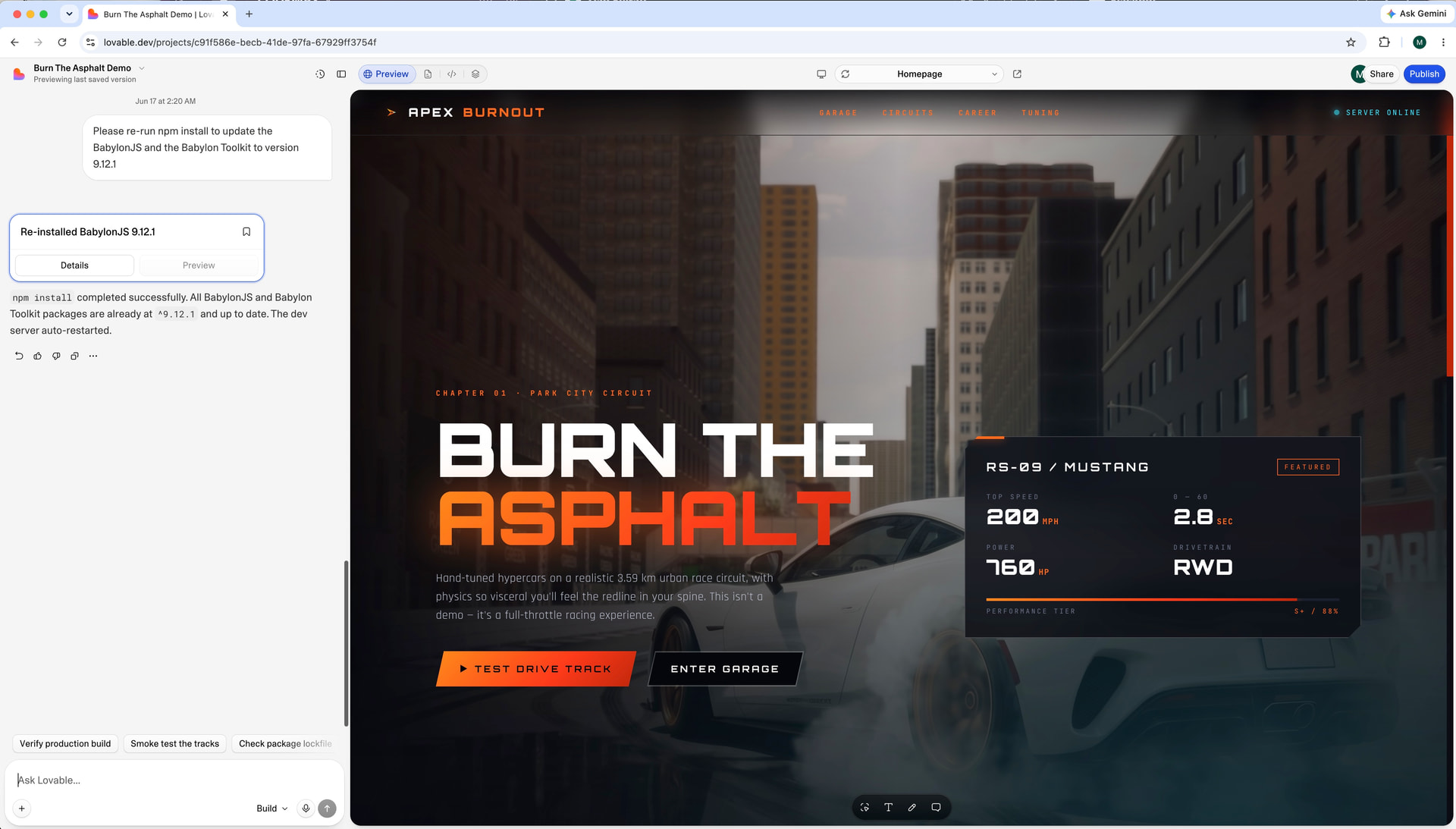
Check out an AI Powered project I am working on using the Babylon Toolkit on Lovable:

OMG :heart_eyes: AI’s understanding of screenshots is great. Just given it a screenshot of my UI / HUD elements of the tactical battle scene. It perfectly understood what the game is about and what questions it had to ask me back. It suggested some very useful design improvements. Since I am not an artist I had some trouble understanding some instructions. No problem :smiley: It gave me mockups in html+css.


Now the implications :open_mouth: :money_mouth_face: You know how long it took me to get an acceptable (as in bare pass) UI ready? Weeks! Now it goes like: “Here is a screenshot of my favourite game…” Then refine and adapt in chat.

Not sure how well actual image gen works these days but in the past I could never get any useful results for UI/HUD designs. The html/css combo seems to be the ideal bridge here.

It may work quite good if you know the right prompts and how to teach a stupid agent :slight_smile:

1 Like